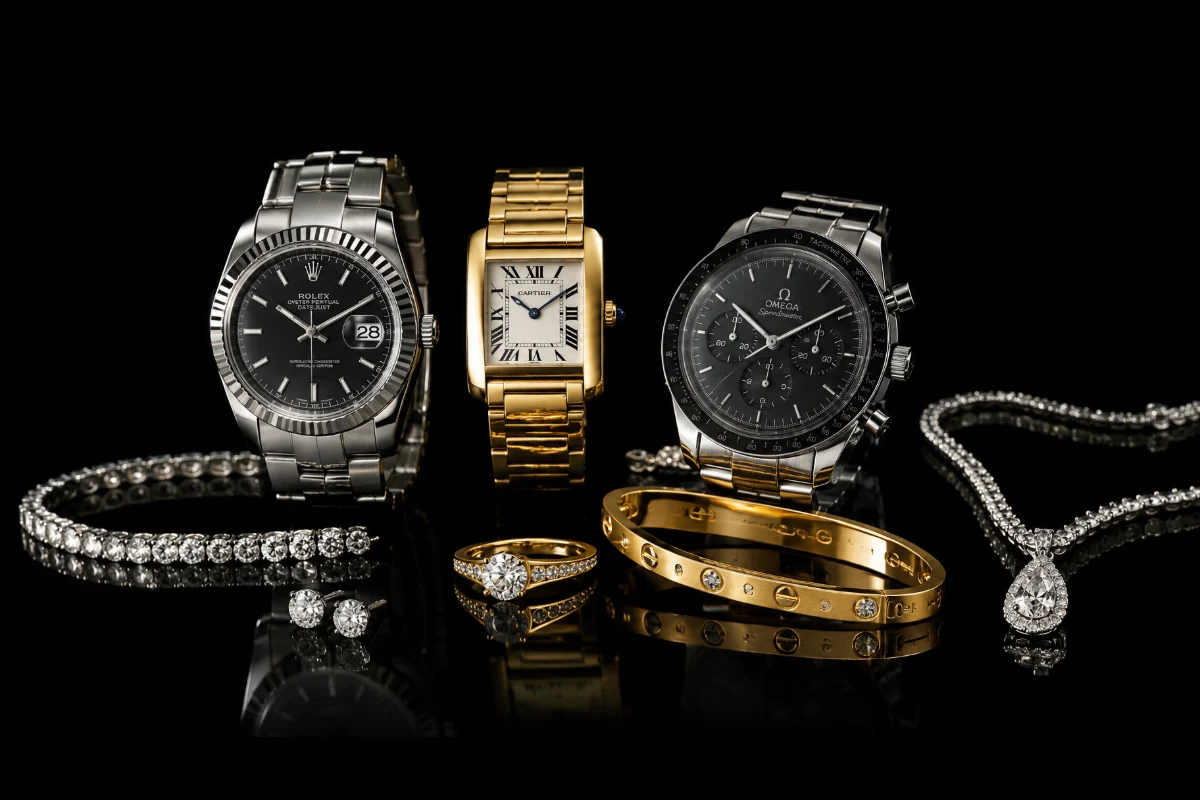
Luxury jewelry marketing is the discipline of building desire, trust, and appointments for fine jewelry and watches without eroding the price integrity that makes those pieces worth owning. In 2026, it means protecting your brand while making your boutique easy to find, easy to trust, and easy to visit, whether a client starts on Google, Instagram, or an AI assistant such as ChatGPT.
The ground has shifted quickly. Jewelry is now leading the luxury category, lab-grown stones have crossed the halfway mark in new engagement rings, and watch buyers are more informed (and more price-aware) than ever. For anyone responsible for luxury jewelry marketing at independent fine jewelers, multi-store groups, authorized watch retailers, certified pre-owned dealers, and direct-to-consumer brands, the old playbook of seasonal sales and generic social posts no longer works.
This guide from Advertising Avenue sets out seven definitive strategies for winning high-net-worth (HNW) clients in 2026. HNW individuals are generally defined as people with at least $1 million in investable assets; ultra-high-net-worth (UHNW) clients hold $30 million or more. Both groups research carefully, expect discretion, and reward jewelers who make the process feel as considered as the pieces themselves.
Why Luxury Jewelry Marketing Looks Different in 2026
Three market shifts are reshaping luxury jewelry marketing and how fine jewelers and watch boutiques should allocate their time and budget this year.
Jewelry is leading luxury, and buyers are more selective. Bain & Company and Altagamma report that personal luxury goods reached €358 billion in 2025 and are forecast to grow 2% to 4% in 2026, with jewelry leading the categories. In watches, Bain notes that “connoisseurship is overtaking hype,” and roughly half of all luxury shoppers now check the secondhand market before buying anything new.
Lab-grown diamonds have become the majority in bridal. According to BriteCo’s appraisal data, lab-grown diamonds appeared in 51% of newly appraised engagement rings from January through June 2026, up from 6% in 2019. The same data put the 2025 median sales price at $12,961 for natural diamond engagement rings versus $4,557 for lab-grown rings.
Watch pricing and availability are in flux. The Federation of the Swiss Watch Industry reported that Swiss watch exports to the United States fell 14.8% in the first half of 2026, measured against a very high first half of 2025. Repeated tariff changes have made pricing communication a marketing task, not just a merchandising one.
Taken together, these shifts change the rules of luxury jewelry marketing. They reward jewelers who market on meaning, expertise, and service, and they punish those who compete on discounts. Here is how to respond.
Strategy 1: Protect Price Integrity, the Foundation of Luxury Jewelry Marketing
What separates luxury jewelry marketing from fashion jewelry promotion is the set of levers it pulls. Fashion jewelry sells on trend, volume, and price. Fine jewelry and watches sell on four things: desire, rarity, provenance, and discretion. Every campaign should strengthen at least one of them.
Discount-led tactics work against all four. A storewide 30% off event teaches clients to wait for the next one, signals that your margins were inflated, and puts your name next to mass-market retailers in their minds. That is why the tactics in our Black Friday marketing tips suit many retailers, but most luxury jewelers should replace markdowns with value-adds: complimentary engraving, a private styling session, extended service coverage, or early access to a new collection.
The “Brand or Discount?” Diagnostic
Answer these five questions honestly to see whether your current marketing is building or eroding price integrity:
- Did more than one of your last five email campaigns lead with a percentage-off offer?
- Do your paid search ads mention price before craftsmanship, certification, or service?
- Would a client struggle to explain what makes your store different from the jeweler down the road?
- Do your product photos look the same as the manufacturer’s stock images on every other site?
- Is your best-performing social content a sale announcement rather than a story about a piece or a client?
If you answered “yes” to two or more, your luxury jewelry marketing is drifting toward discounting. The remaining strategies show how to shift the weight back toward brand.
Strategy 2: Position Natural, Lab-Grown, and High Jewelry Without Undermining Your Brand
With lab-grown stones now in a majority of newly appraised engagement rings, every fine jeweler’s luxury jewelry marketing needs a deliberate position. Ignoring lab-grown cedes a large share of bridal buyers to competitors. Blending it into the natural assortment without explanation confuses clients and can quietly devalue your natural and high jewelry.
The most effective luxury jewelry marketing approach treats each category as its own story:
- Separate collections and pages. Give lab-grown its own collection name, landing pages, and photography style. Keep natural diamonds and high jewelry positioned on rarity, origin, and heirloom value.
- Transparent education. Explain origin, certification (GIA and IGI both grade lab-grown stones), and value retention in plain language. BriteCo’s data shows the median lab-grown price per carat fell from $4,622 in 2019 to $2,057 in 2025, so honesty about resale expectations builds trust.
- Compliant labeling. The FTC’s Jewelry Guides require lab-grown stones to be clearly disclosed with terms such as “laboratory-grown” or “laboratory-created.” Apply that standard on product pages, ads, and social captions.
- Respect for both buyers. Avoid copy that frames lab-grown as the “cheap” option or natural as the “outdated” one. Clients choose for budget, ethics, size, and meaning, and your advisors should support every reason.
Strong luxury jewelry marketing lets a couple choose a 2-carat lab-grown solitaire today and return for a natural anniversary band in five years, without either purchase feeling like a compromise.
Strategy 3: Market Watches to Connoisseurs: Authorized, Certified Pre-Owned, and Tariff-Era Messaging
Bain’s observation that connoisseurship is overtaking hype describes today’s watch buyer well: informed, patient, and comparing new, pre-owned, and vintage options side by side. Luxury jewelry marketing for watches should meet that buyer with expertise rather than urgency.
Authorized Dealers: Work Inside the Brand Agreement
Authorized retailers must follow each manufacturer’s rules on pricing, imagery, and advertising. Differentiate on what the brand cannot provide: your watchmakers, your service department, your events, and the relationships your advisors keep. Local content about your boutique, team, and service experience is often the only fully owned asset an authorized dealer has.
Certified Pre-Owned: Lead with Authenticity
To market certified pre-owned (CPO) watches, publish a detailed page for each watch with photos of the actual piece, its reference number, condition grade, box and papers status, service history, and warranty terms. Explain your authentication process step by step. Because roughly half of luxury shoppers check the secondhand market first, strong CPO content also reaches new-watch buyers early in their research.
Tariff-Era Communication: Calm and Specific
When prices or allocations change, tell clients directly and early. A short note from their advisor explaining what is changing, why, and which pieces are available now builds more loyalty than a public “buy before prices rise” campaign, which can feel like pressure. The table below compares luxury jewelry marketing priorities by business model.
| Priority | Authorized Dealer | CPO Specialist | DTC Fine Jewelry Brand |
|---|---|---|---|
| Main constraint | Brand guidelines and pricing rules | Trust and authenticity | Awareness and credibility |
| Key content | Boutique, service, and events | Per-watch pages and certification | Founder story, materials, and process |
| Strongest channels | Local SEO, email, and events | SEO, marketplaces, and video | Social, paid media, and PR |
| Primary conversion | Appointment or waitlist | Inquiry or video viewing | Online purchase or showroom visit |
Strategy 4: Build Product Pages and Media That Sell a $20,000 Piece Online
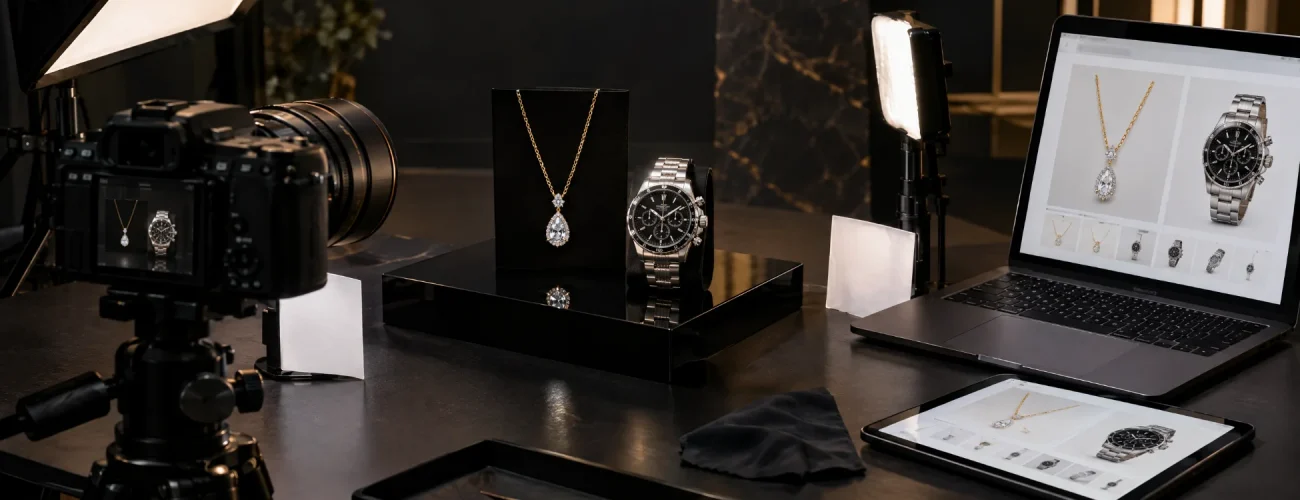
In luxury jewelry marketing, the product page is your digital showcase. Few clients will buy a $20,000 bracelet from a single small photo and a paragraph of manufacturer copy. The product page has to do the work your best advisor does in the boutique: show the piece in detail, answer questions before they are asked, and make the next step obvious.
A high-converting fine jewelry product page includes:
- Macro video and 360-degree views that show sparkle, movement, and finish under natural and studio light.
- On-body or on-wrist imagery to communicate scale.
- Visible certification details, such as the GIA or IGI report number with a link to the report, and the 4Cs presented clearly.
- A provenance or design story that explains where the piece came from and who made it.
- Two clear paths forward: secure checkout for suitable pieces, plus “Book a private viewing” and “Ask an advisor” for higher-value items.
- Transparent policies for returns, sizing, insurance, and shipping.
- Accurate Product schema so search engines and AI assistants can read price, availability, and materials. Our guide to schema markup and rich snippets covers the basics.
Image quality also drives discovery. Clients increasingly search with Google Lens and other visual tools, so original, well-labeled photography gives you an advantage over retailers using shared stock images. Our visual search optimization service covers the technical side, while our e-commerce web design team builds the product templates that bring this level of luxury jewelry marketing to every page of your catalog.
Strategy 5: Turn Long Bridal Research Cycles into Booked Appointments
An engagement ring is often the largest jewelry purchase a couple will make, and the research can run for weeks or months. They read guides, compare cuts and settings, save photos, and visit several stores. Bridal luxury jewelry marketing has one job: stay present across that journey and make booking a visit the natural next step.
- Educational content by stage. Early research needs guides on cuts, metals, and natural versus lab-grown. Later research needs pages on your custom design process, pricing ranges, and what happens at an appointment.
- High-intent paid search. Queries such as “custom engagement rings near me” or a specific designer name signal readiness to visit. Pay-per-click advertising lets you appear for those searches with appointment-focused ad copy.
- Thoughtful retargeting. Remind visitors of the styles they viewed and invite them to see those pieces in person, without countdown timers or discount codes.
- Appointment-first UX. Make booking available from every product page, offer video consultations, and confirm appointments with a short note about what to expect.
Plan your bridal luxury jewelry marketing calendar around peak engagement season, which traditionally runs from Thanksgiving through Valentine’s Day. Publish education in early fall, increase paid search in November, and promote private bridal events in January and February.
Strategy 6: Earn AI and Local Search Visibility for Your Jewelry Store
Does SEO still work for jewelry stores? Yes, and its reach now extends into AI. When a client asks ChatGPT, Gemini, or Google AI Mode for “the best place to buy an engagement ring in Fort Lauderdale” or “a trusted dealer for pre-owned watches,” the answer draws on your website, your reviews, and what third-party sources say about you. Luxury jewelry marketing has to earn visibility in both places.
Luxury Jewelry Marketing Foundations for Google and AI Assistants
- Consistent business data. Make sure your name, address, hours, and services match across your Google Business Profile, Apple Maps, Yelp, and industry directories.
- Reviews that mention specifics. Encourage clients to describe what they bought and how they were treated. Detailed reviews give AI models useful language to quote.
- Cited third-party sources. Press coverage, designer partner pages, and association memberships help models recognize you as an authority.
- Local landing pages. If you serve several cities or neighborhoods, create a useful page for each with real details about directions, parking, and services.
Our generative engine optimization service helps jewelers appear in AI-generated answers. To see how AI currently describes your store, read our guide to AI brand monitoring.
Strategy 7: Use Events, Trunk Shows, and Private Previews to Build a Collector Base
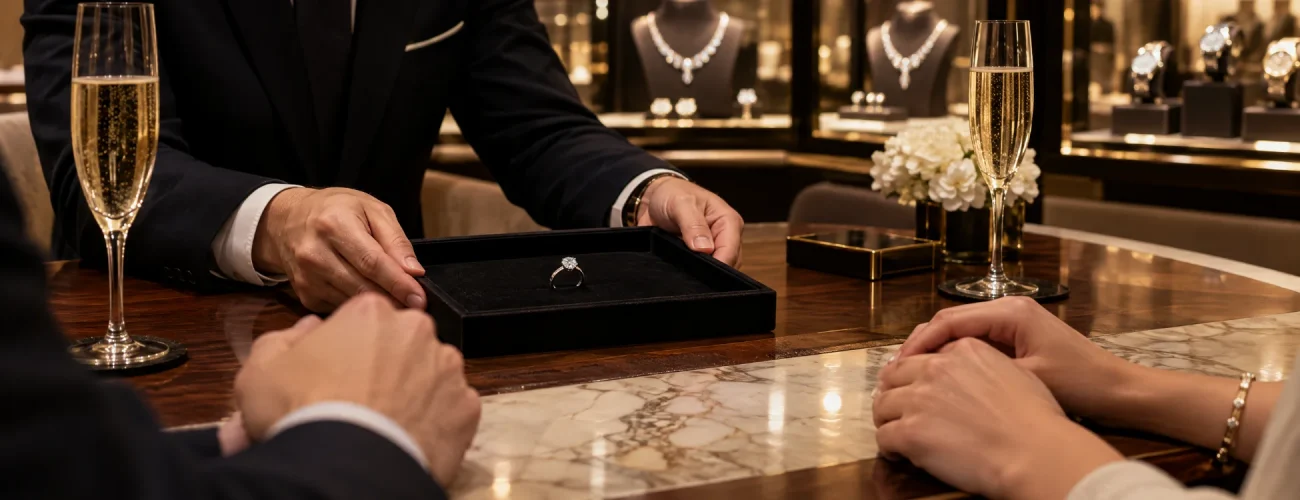
Events remain one of the most powerful luxury jewelry marketing tools a fine jeweler has, because they deliver what websites cannot: the weight of a piece in the hand, a conversation with the designer, and the feeling of being invited.
To plan events that strengthen your luxury jewelry marketing:
- Keep the guest list intentional. Invite top clients, recent bridal clients, and a small number of high-potential prospects. Exclusivity is part of the appeal.
- Partner with designers. Trunk shows bring collections you do not normally stock and give clients a reason to visit now.
- Promote with care. Use personal invitations first, then email and private social stories. Our social media management team can capture the event for clients who could not attend.
- Measure what matters. Track attendance, appointments booked within 30 days, sales attributed to attendees, and new client records created.
- Capture preferences. Note each guest’s ring size, metal preference, favorite designers, and upcoming milestones so your advisors can follow up personally.
That last step turns a single evening into long-term clienteling. Over time, those notes become a collector base that responds to a new piece without any advertising at all, which is the ultimate goal of luxury jewelry marketing.
Bringing Your Luxury Jewelry Marketing Together
The jewelers and watch boutiques that win in 2026 will treat luxury jewelry marketing as an extension of the showroom. They will protect price integrity, position every category with confidence, publish product media worth studying, guide bridal clients toward appointments, earn trust in Google and AI search, and invite their best clients into experiences no website can replicate.
Advertising Avenue has spent years helping luxury brands build digital experiences that match the quality of what they sell. Browse our portfolio to see that work.
Ready to see where your digital showroom stands? Request a Digital Showroom Audit from Advertising Avenue. We review your product pages, media, local search presence, and AI visibility, then provide clear priorities for your luxury jewelry marketing. Contact our team to schedule yours.
We would love to hear from you: how are you positioning lab-grown diamonds with your clients this year?
Frequently Asked Questions
The best luxury jewelry marketing strategy protects price integrity while making the jeweler easy to discover and trust. That means clear positioning (natural, lab-grown, high jewelry, or watches), exceptional product media, appointment-first journeys, consistent local and AI search visibility, and invitation-only events that build a collector base. Discount-led promotion usually works against a luxury jeweler.
Jewelry stores attract high-net-worth (HNW) clients, generally people with $1 million or more in investable assets, by offering expertise, discretion, and exclusive access. Private appointments, designer trunk shows, detailed product pages with certification, strong reviews, and personal follow-up from a dedicated advisor matter far more to these clients than promotions.
Treat lab-grown as a distinct, clearly labeled category with its own messaging, rather than as a cheaper version of natural diamonds. Educate transparently on origin, value retention, and certification, and keep natural and high jewelry collections positioned on rarity and provenance. BriteCo reports that lab-grown stones appeared in 51% of newly appraised engagement rings in the first half of 2026.
Lead with authenticity and confidence: your certification process, warranty, service history, and photography of the actual piece. Publish detailed pages for each watch, explain condition grading, and offer appointments or video viewings. Bain reports that roughly half of luxury shoppers check the secondhand market before buying new, so CPO content also reaches new-watch buyers.
Yes. Jewelry buyers research for weeks, especially for engagement rings, and many searches are local or specific, such as a designer, a cut, or a watch reference. As part of a broader luxury jewelry marketing plan, SEO for product pages, local search, and educational content captures that research. It also builds the reviews and third-party mentions that AI assistants rely on when recommending jewelers.
A luxury jewelry website needs high-resolution photography and macro video, visible certification details, transparent policies, appointment booking, advisor contact options, secure checkout for suitable pieces, and accurate Product schema. It is the hub of your luxury jewelry marketing, so it should feel as considered as the boutique itself and load quickly on mobile.
Replace markdowns with value-adds such as complimentary engraving, extended service coverage, private viewings, or early access to new collections. Pair those with detailed product media, certification, and an easy path to speak with an advisor. Clients buying high-value pieces want confidence more than a lower price.